
How to Choose an App Development Firm: A Practical Guide
October 6, 2026 · Updated October 19, 2026
Short answer: choose an app development firm on proof and process rather than portfolio polish: live apps similar to yours, a reasoned recommendation between native and cross-platform, strong back-end and testing practices, clear ownership of the code, and a plan for support after launch. Compare at least three firms against the same brief, and treat a fixed price given before any discovery as a red flag.
Choosing among app development firms is less about finding the flashiest portfolio and more about finding a partner that can turn a business goal into reliable software. The right team will help you clarify scope, select the right technology, manage delivery, and support the app after launch. Whether you are comparing national software engineering firms, a local agency or a nearshore partner, the best choice is the one whose process, technical depth, and communication style fit your project.
What should you look for in an app development firm?
Look for a firm that understands both product strategy and engineering execution. Strong mobile app developers should be able to explain how your app will serve users, how it will connect with existing systems, what risks may affect the build, and how they will maintain quality over time. A good partner will not simply ask for a feature list; they will challenge assumptions, identify missing requirements, and help you prioritize what matters most for launch.
The evaluation should start with business fit. A startup building a first version may need speed, lean planning, and flexible app development services. An enterprise team may need deeper discovery, security reviews, integrations, compliance awareness, and long-term support. Neither approach is automatically better. The key is choosing a firm that has delivered work with similar complexity, constraints, and stakeholders.
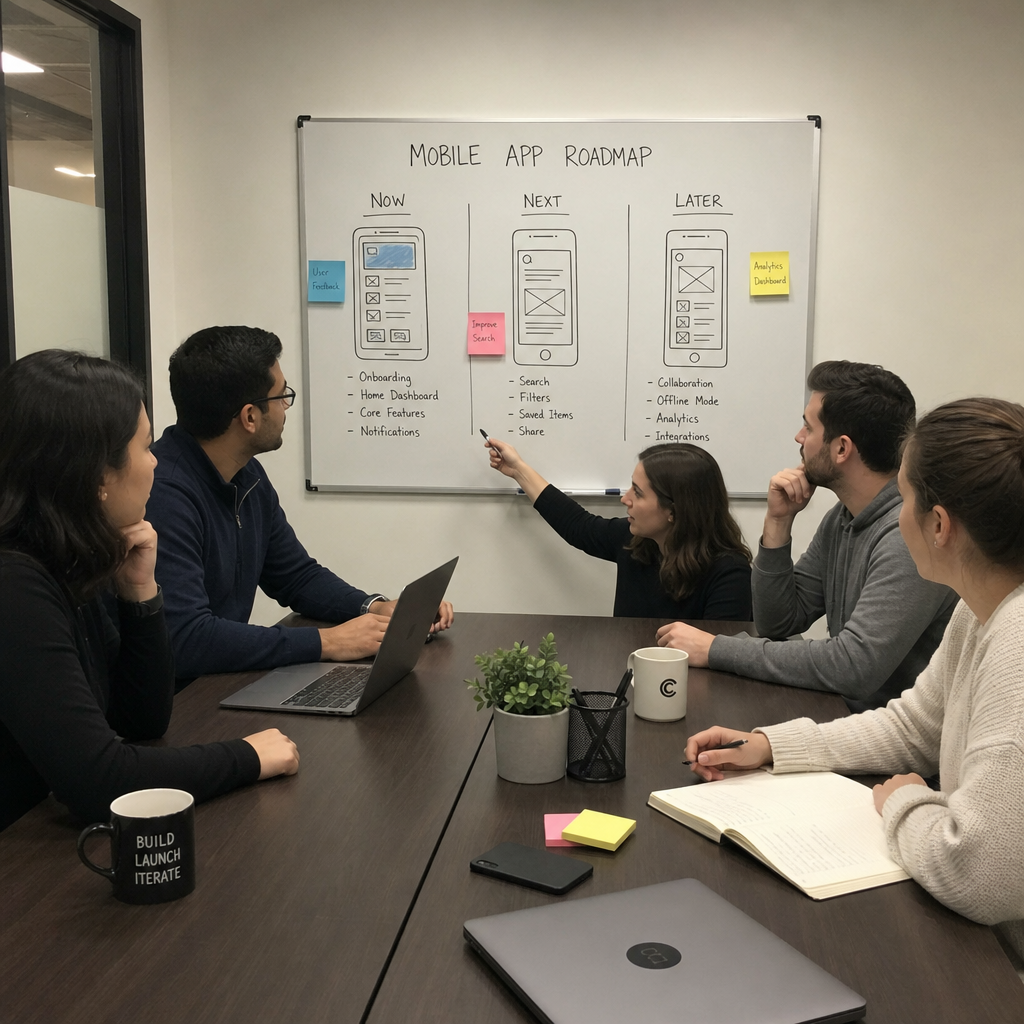
The strongest firms combine strategy, design, and engineering
Many projects fail before development begins because the team rushes from an idea into screens and code. Experienced software development firms usually begin with discovery: defining the audience, business goals, core features, technical dependencies, and launch priorities. This phase may feel slower than jumping straight into development, but it helps prevent costly changes later.
Design is equally important. A mobile app is not just a set of functions; it is a user experience shaped by speed, clarity, accessibility, and trust. Good firms test navigation, reduce unnecessary steps, and design interfaces that support real user behavior. For customer-facing apps, this can affect adoption. For internal enterprise apps, it can affect training time, productivity, and whether teams actually use the tool.
Engineering brings the product to life, but quality depends on more than writing code. Look for practices such as code reviews, automated testing, version control, sprint planning, and release management. These habits may not sound exciting, yet they are what help an app remain stable as features, users, and integrations grow.
Local, national and nearshore firms offer different advantages
A local firm can make sense if your team values in-person workshops, shared business hours, and familiarity with your regional market and industries. For projects with many stakeholders, being in the same time zone makes planning and decision-making easier.
National firms can bring broader specialization, larger teams, and experience across more markets. Some companies prefer this when they need niche expertise, such as connected devices, advanced analytics, or complex enterprise architecture. The trade-off is that larger firms may have more structured processes and higher overhead, while smaller firms may offer closer senior attention but fewer specialized roles.
A nearshore firm, a team in a nearby country and a similar time zone, sits between the two. For US companies, a partner in Canada works the same or overlapping hours, can meet in person after a short flight, and often brings senior talent and specialized experience. The difference from offshore teams many time zones away is real-time collaboration: questions get answered the same day, not overnight.
No option guarantees success. A local firm with weak process is still a risk, and a large firm with impressive credentials may not be the right fit for your budget or culture. Focus on relevance: similar project experience, clear communication, transparent planning, and a support model that matches the seriousness of your app.
Native, Flutter, and React Native each fit different goals
Technology choice should follow product needs, not trends. Native development, usually separate builds for iOS and Android, can be a strong choice when performance, platform-specific features, security, or complex device capabilities matter most. It may require more budget and coordination, but it gives teams high control over the user experience.
Cross-platform development can help teams launch faster with a shared codebase. Flutter app development companies often appeal to teams that want expressive interfaces and consistent experiences across platforms. React Native app development companies may be attractive when a business already uses JavaScript talent or wants a mature cross-platform ecosystem. Both can be effective, but the right choice depends on app complexity, team skills, integrations, and long-term maintenance expectations.
Use this simple comparison when discussing options with potential partners:
| Approach | Best fit | Watchouts |
|---|---|---|
| Native iOS and Android | High-performance apps, advanced device features, strict platform standards | Higher cost, separate platform teams, longer coordination |
| Flutter | Consistent UI across platforms, fast iteration, custom visual experiences | Requires relevant Flutter expertise and careful plugin evaluation |
| React Native | Shared codebase, JavaScript-friendly teams, many common app types | Native modules may be needed for complex features |
| Hybrid or web-based app | Simple tools, internal apps, limited device needs | May feel less polished for demanding mobile users |
A reliable firm should be able to explain the trade-offs without pushing one framework for every project. If a vendor recommends a stack before understanding your users, integrations, and roadmap, slow down.
How do costs and timelines usually vary?
Costs and timelines vary because mobile apps vary widely in scope, risk, and technical complexity. A simple app with limited screens and basic backend needs is very different from an enterprise platform with authentication, role permissions, third-party integrations, analytics, compliance requirements, and ongoing feature releases. Instead of asking for one universal price, ask firms to explain the assumptions behind their estimate.
Several factors tend to shape budget and schedule:
- Product complexity: More user roles, workflows, and edge cases require more planning, design, testing, and development.
- Platform strategy: Building for iOS, Android, tablets, and web may affect team size and delivery sequence.
- Backend requirements: Apps that need databases, admin panels, APIs, or integrations are larger than apps with mostly static content.
- Security and compliance: Healthcare, fintech, and enterprise apps often require stronger controls, documentation, and review cycles.
- Design depth: Custom design systems, animations, and accessibility work can improve quality but add effort.
- Post-launch roadmap: A product meant to evolve needs architecture that can support future features, not just the first release.
Be cautious with estimates that sound precise before discovery. Early numbers should be framed as ranges or phases. The most trustworthy firms explain what is included, what is excluded, what could change, and how they will communicate budget movement during the project.
Industry experience matters more than a long client list
Many articles listing the top 10 mobile app development companies focus on brand names, awards, or broad rankings. Those lists can be useful for research, but they should not replace due diligence. The best firm for a healthcare workflow, a fintech product, a logistics tool, or a retail loyalty app may be different in each case.
Industry context changes the questions a development team needs to ask. A healthcare app may involve privacy, consent, secure messaging, and patient data workflows. A fintech app may require careful attention to identity, transaction security, audit trails, and trust signals. A retail app may depend on inventory systems, promotions, loyalty accounts, and performance during traffic spikes.
When reviewing top mobile app development companies, look beyond screenshots. Ask what business problem the app solved, what integrations were involved, how success was measured, and how the team handled constraints. If a case study looks impressive but does not resemble your situation, treat it as a design sample rather than proof of fit.
A practical checklist for comparing firms
A structured review helps you avoid choosing based on personality, sales polish, or the lowest bid. Use the same questions with every firm so you can compare answers fairly.
- Relevant experience: Have they built apps with similar users, workflows, integrations, or security needs?
- Discovery process: Do they help define scope, risks, user journeys, and priorities before estimating in detail?
- Technical recommendation: Can they clearly explain why native, Flutter, React Native, or another approach fits your project?
- Team structure: Who will work on strategy, design, development, QA, project management, and post-launch support?
- Communication rhythm: Will you have sprint reviews, demos, written updates, and clear escalation paths?
- Quality assurance: How do they test across devices, operating systems, user roles, and edge cases?
- Ownership and documentation: Will you own the code, designs, accounts, and technical documentation?
- Maintenance model: What happens after launch when bugs, updates, security patches, and new features are needed?
This checklist works for both startups and enterprise teams. The answers may differ, but the need for clarity does not.
Post-launch support is part of the product, not an add-on
The launch is not the finish line. Mobile operating systems change, devices evolve, dependencies need updates, and users discover issues that did not appear in testing. Firms that treat support as an afterthought can leave you with a product that becomes harder to maintain every month.
Before signing, ask what support looks like after release. Some firms offer monthly retainers, while others provide support blocks or dedicated enhancement teams. The right model depends on how critical the app is to your business. An internal scheduling app may need light maintenance; a revenue-generating customer app may need monitoring, fast response times, analytics review, and a planned release cadence.
For enterprise work, discuss service expectations in plain language. Who responds to urgent issues? How are bugs prioritized? How often are security updates reviewed? How will new feature requests move from idea to release? These questions protect both sides and create a healthier long-term partnership.
Red flags that deserve attention
Some warning signs appear early in the sales process. A firm that promises a fixed price without understanding requirements may be underestimating the work or planning to limit flexibility later. A team that cannot explain its process may struggle when the project becomes complex. A portfolio full of attractive visuals but little technical detail may indicate shallow experience.
Other red flags include vague ownership terms, no clear QA approach, limited access to the actual delivery team, and resistance to documentation. Be careful if every answer sounds like a sales pitch. Strong firms are willing to discuss trade-offs, risks, and constraints because they know those conversations lead to better products.
The best partner makes decisions clearer
Choosing among app development firms is ultimately a decision about trust, clarity, and fit. The right partner helps you understand what to build first, which technology choices support your goals, what risks need attention, and how the app will be supported after launch. Whether you are comparing local options, specialized software engineering firms, or a nearshore team, prioritize partners that communicate clearly and think beyond the first release.
A polished app starts with a disciplined partnership. Take time to ask better questions, compare firms consistently, and choose the team that can support both your launch and your long-term product roadmap.
How Algoseed Labs approaches mobile app projects
We're a software and AI development team in Montréal that builds native iOS and Android apps, cross-platform apps with React Native and Flutter, and the back ends behind them. Every project starts with discovery, and you own the code, designs and documentation. See our mobile app development services and the Wescoop case study, or, if you're a US company, how we work as a nearshore partner on Eastern Time. Tell us about your app.